


A farewell to Thuya Garden’s oldest tree

Updated: Jun 17

"Love is like a tree, it grows of its own accord,
it puts down deep roots into our whole being."
― Victor Hugo
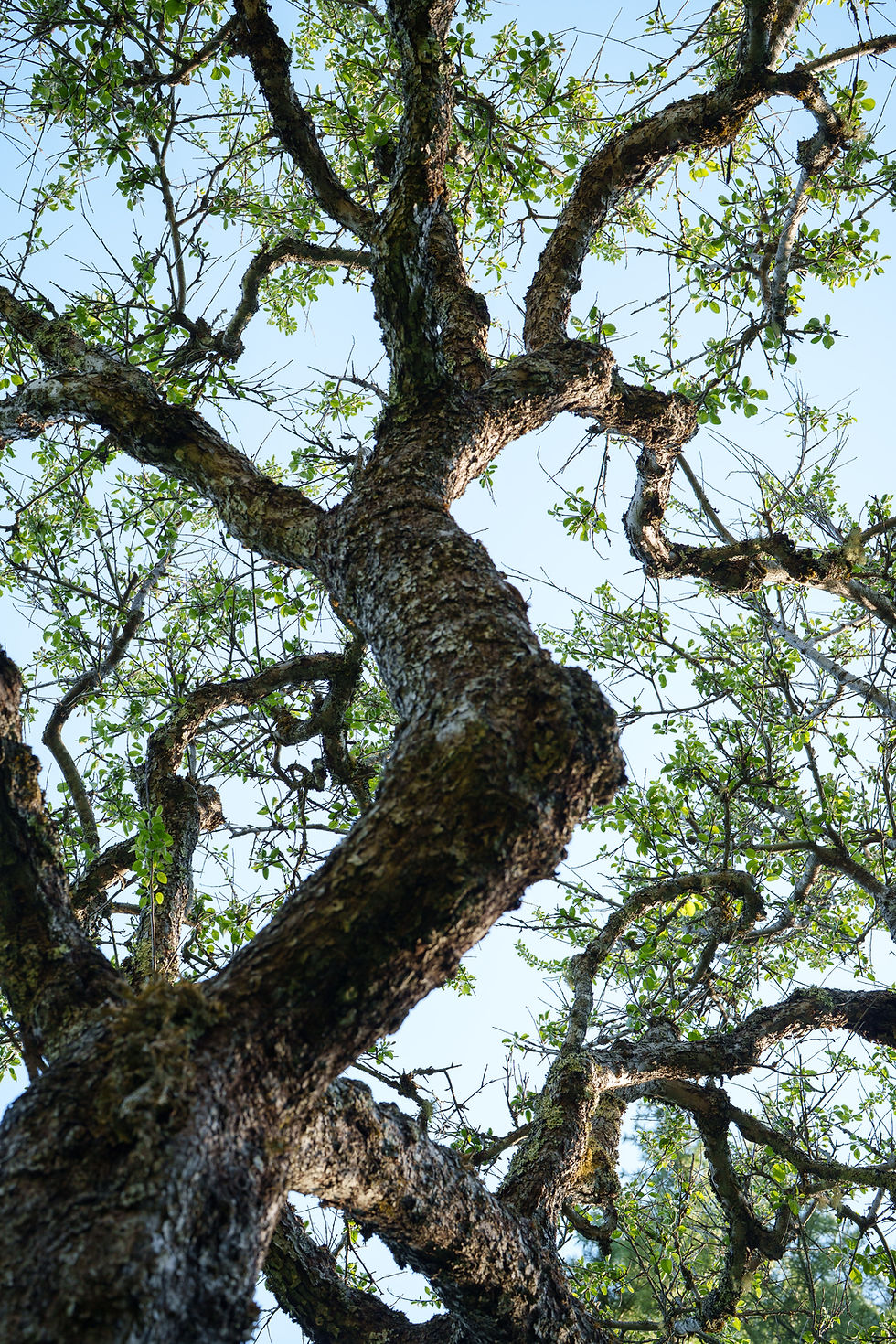
People form deep connections to landscapes. Sometimes it is to an entire garden; other times, it is to a single element they return to see, year after year. For more than sixty years, visitors have come to Thuya Garden. Some return faithfully, across generations. Through all those seasons, one presence has remained constant: the apple tree at the heart of the border gardens. They have watched it flourish, and now they are watching it ease back into the landscape where it has grown for decades.
The “Wise Old Apple” of Thuya Garden
Long before Thuya Garden became one of Mount Desert Island’s most beloved public landscapes, the level ground behind Thuya Lodge served a different purpose. The space held a small, working orchard with rows of hardy fruit trees planted by Joseph Henry Curtis, the property’s original owner.
Among them were about a dozen Wealthy apple trees and several cherry trees, planted sometime in the years just after the construction of Thuya Lodge, likely in the mid‑1910s. Curtis, a Boston landscape architect who made Northeast Harbor his summer home, chose the Wealthy variety deliberately. Introduced in the 19th century and widely planted across northern New England, Wealthy apples were known for their cold hardiness, reliability in shorter growing seasons, and versatility in the kitchen. They were a practical, sensible choice.
The Wealthy apple tree, Malus domestica, originated from the open-pollinated flowers of a Cherry Crab, produced by Albert Emerson in Bangor, Maine. In 1861, horticulturalist Peter Gideon of Excelsior, Minnesota purchased a number of pips and shoots from Emerson as part of his attempt to find apples that would tolerate the harsh winters of Minnesota. From among these, he selected one seedling that showed great promise and, in 1893, he introduced the Wealthy apple, named for Wealthy Gideon (Hull), Peter Gideon’s wife.
Apples also played a role in Curtis’ positive feelings toward temperance in the use of alcohol, stressing rationality and moderation. In a 1917 essay, written during the heated debates around prohibition, Curtis consulted his “wise old Apple” who assured him that “…as long as there is a single apple tree left, New England can never be made bone dry.”
Today, only one of those original trees in the former Thuya orchard remains.
From orchard to garden
When landscape designer Charles K. Savage transformed the former orchard into Thuya Garden between 1956 and 1961, one tree was spared.

Planted over a century ago, around 1915, the tree has reached an estimated age of 100 to 110 years. This longevity is not unusual for apples grown on standard rootstock, but what is remarkable is the care it has received. Unlike many historic orchard trees on Mount Desert Island, which survive in abandoned fields or along forest edges, the Thuya apple has been continuously tended as part of the landscape.
The end of a life cycle
Now, after more than a century, the Thuya apple tree is nearing the end of its life.
Though it has been carefully maintained for decades, the tree is experiencing structural decline, an inevitable stage for a tree of its age. For reasons of visitor safety and long-term landscape stewardship, plans are in place to remove the tree during the winter of 2026–2027, as long as it remains viable until then.
Its removal will be handled with care and intention. Future decisions about the site will be guided by the upcoming Cultural Landscape Report, ensuring that the next chapter is grounded in the same respect for history that preserved the tree for so long.
To honor and memorialize the tree, Preserve staff will be sharing facts and stories of the tree with garden visitors this season with an exhibit in the Herbals Room in Thuya Lodge. There will also be opportunities for visitors to share their memories and reflections in a dedicated scrapbook on site. We invite you to visit Thuya Garden this season, spend time with the “wise old apple,” and add your own memories to its story.


Comments