


Planting the next generation of trees

Updated: Jun 18

As you walk along the carriage roads at Little Long Pond, you may notice some new additions. This spring, we planted a dozen young trees intended to become the next generation of our stately specimen trees.
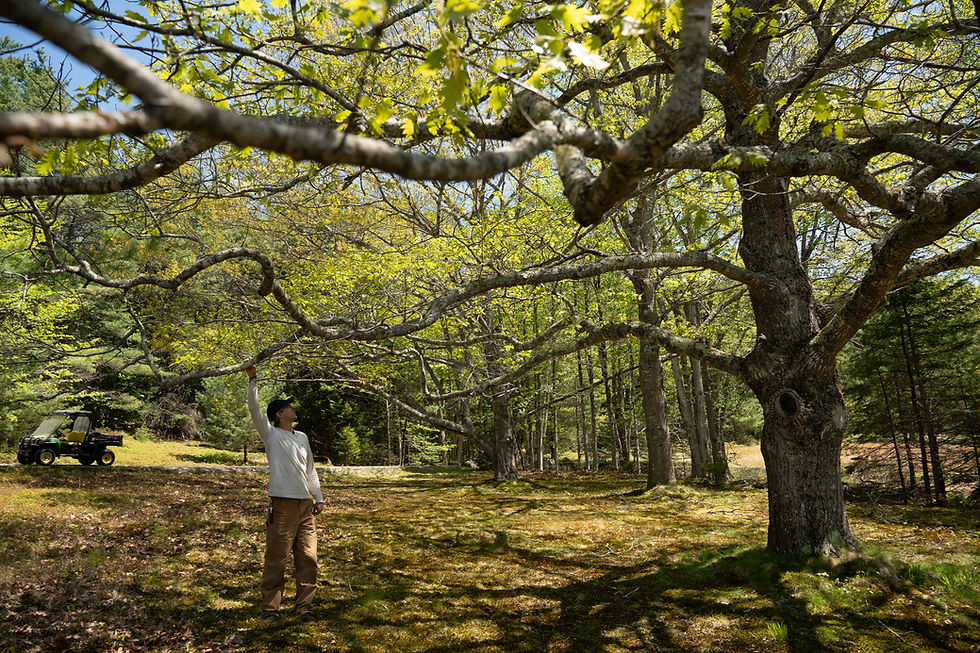
Many of the large trees that line the meadow edges are more than 100 years old, some possibly much older. While they remain an important part of the landscape, they are now in the latter half of their lives. Our goal is to establish the next cohort of large, open-grown trees. To develop the wide, spreading crowns that define these specimens, trees need abundant light and space from an early age.

Why not simply let nature take its course? The short answer: deer. White-tailed deer browse heavily on nearly all our native hardwoods, making it extremely difficult for young trees to establish, especially in the open, sunny conditions required for them to grow large. Natural regeneration in these areas often conflicts with other management goals as well, such as preserving scenic vistas and maintaining buffers along carriage roads and near structures. Planting allows us to ensure the right trees grow in the right places.
Why big trees matter
If you are reading this, you likely already appreciate the value of big trees. They are often old, and in that way, they connect us to the past. Over time, they develop the character and complexity that make them so compelling—like the red maple nearby, with its massive trunk, broken limbs, and cavernous hollows.
Because of past agriculture and logging, forests across Maine and the eastern United States are not very old. It’s easy to forget just how large and expressive trees can become when given the time and space. We hope these plantings will, in time, inspire that sense of wonder and help cultivate the next generation of land stewards.
Planting for the future
Planting trees also gives us the opportunity to think strategically about species selection. With a changing climate, many plant and animal species will need to shift their ranges to survive. While animals can often move more easily, plants face greater challenges. Human development like roads, cities, and fragmented landscapes, can slow or even prevent this natural migration.

With this in mind, three of the species we planted fall just outside their current natural ranges. This was a deliberate choice to support their gradual movement northward, while also increasing the diversity of trees on our natural lands.
All these trees were grown from seeds collected by staff in our propagation facility at McAlpin Farm. At planting, they range from one to six feet tall and are protected by small metal enclosures to prevent deer browse. We will continue to hand-water and care for them until they are well established.
By collecting our own seeds, we also know each tree’s origin, allowing us to follow its story as it, we hope, grows into a long-lived and defining feature of the landscape.
Spring 2026 new tree plantings
COMMON NAME | SCIENTIFIC NAME | SEED SOURCE | NATIVE TO | WHY USE? |
White oak | Quercus alba | Two sources: Wild - Oxford, Maine; Arnold Arboretum (Massachusetts) | Huge range in central/eastern USA. Maine, Hancock County. Does not grow wild on MDI, but may have historically. | Beautiful tree, long lifespan, one of the most important eastern trees for supporting wildlife biodiversity. |
Black oak | Quercus velutina | Wild - Oxford, Maine | Huge range in central/eastern USA. Maine, Hancock County. Does not grow wild on MDI. | Beautiful tree, long lifespan, supports biodiversity. |
Black gum, tupelo | Nyssa sylvatica | Wild - Harvard Forest (Massachusetts) | Huge range in central/eastern USA. Southern Maine. Does not grow wild in Hancock County. | Beautiful (red) fall foliage, very long lifespan. |
Black cherry | Prunus serotina | Wild - Carmel, New York | Huge range in central/eastern USA. Maine, Hancock County. Uncommon on MDI. | Grows quickly, fruits are eaten by wildlife, host tree for many species of moth and butterfly larva (caterpillars). |
Yellow birch | Betula allegheniensis | Wild - Seal Harbor, MDI | Huge range in central/eastern USA. Maine, Hancock County. Abundant on MDI. | Beautiful tree, long lifespan, We know it performs well in our soil/climate. |


Comments