


Digging into history: What clay at Little Long Pond can tell us

Updated: Mar 17
Geology was certainly not my first love, but geology has grown on me since I learned to use it to better understand the living landscape around me. For example, soil can influence the plants found in a given area, while simultaneously telling us about the past. In this article I will describe some soil found at Little Long Pond natural lands and the historic environment in which it was formed.
I dig a lot of holes. Setting posts, setting rocks, building trails, and planting trees all require digging holes. If you dig a hole in some of the low-lying areas around Little Long Pond, you will find gray-colored clay. If you consult a soil map of Mount Desert Island you will see that this silty clay is called Presumpscot formation and is a marine clay, which means that it formed in the ocean. It was not formed by the modern day Atlantic Ocean, per se, but instead the Atlantic Ocean at the time the last ice age was coming to an end, ~16,000 years ago.

What was so special about the Atlantic Ocean at the end of the last ice age? Nothing really, except that sea level was about 230 feet above today’s sea level. That means Little Long Pond was under the ocean, the Boathouse was under the ocean, and virtually all the Preserve’s carriage roads were under the ocean. Much of Little Long Pond natural lands would have looked like a modern-day harbor or cove: ocean water all the way past the Cobblestone Bridge and more than halfway up Barr Hill. As streams entered this hypothetical Little Long Pond harbor, they deposited silty clay that formed deep deposits that we can see and dig up today.
Why was sea level so high? This is where the story gets a little bit unbelievable yet, apparently, scientifically verifiable. Let’s start with the earth’s tectonic plates—the continent-sized slabs of solid rock that float on a semi-fluid bed. If you push down on one of earth’s plates with a lot of weight it will sink a little. Visualize a waterbed adjusting to your weight. What in nature is large and heavy enough to push down on a tectonic plate and cause it to sink (or downwarp) a little? An ice sheet! The ice sheet that covered this part of the world during the last ice age was so heavy that it caused our plate to downwarp a few hundred feet.
In a relatively short amount of time (a few thousand years), the ice sheet melted and allowed the ocean to advance upon the land. You may be thinking, “But once the ice sheet melted, wouldn’t the tectonic plate respond by rising?” Yes, the tectonic plate did respond by rising, technically called rebound, just like a waterbed would respond after you got off it, but the plate rebounded slowly compared to how fast the sea level rose, and in the meantime everything under 230 feet was under water for a short amount of time, geologically speaking.

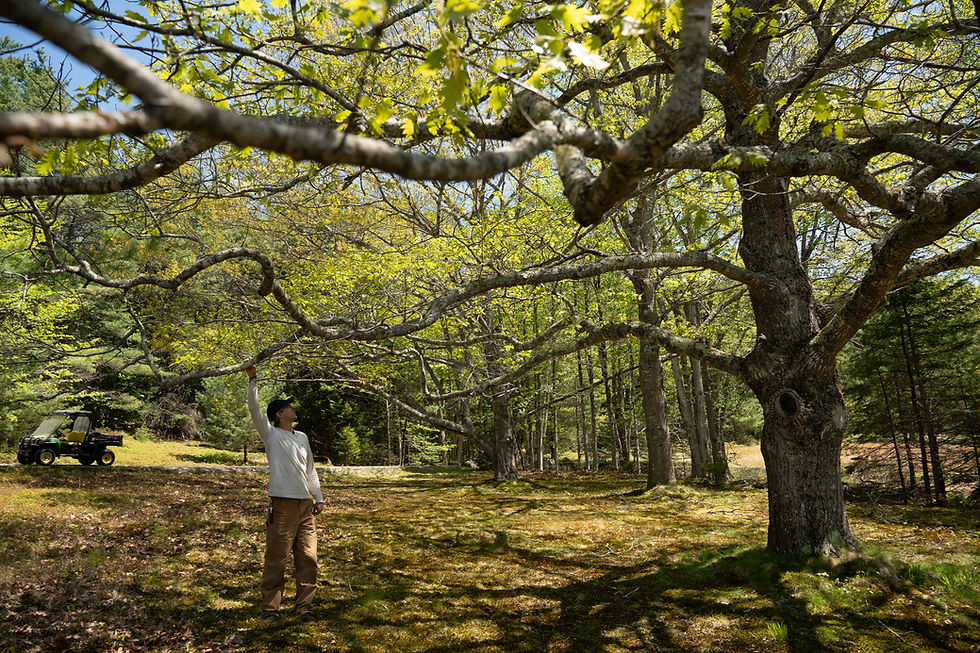
Back to the clay. Any farmer or gardener can attest that a clay-rich soil has its issues. You shouldn’t work it in the spring when it is saturated and easy to compact. It is very slippery when wet. It is hard as a rock when it dries out. Some plant roots simply hate it. When we plant trees on the natural lands, we wouldn’t plant a red oak (Quercus rubra) into clay, but a red maple (Acer rubrum) would do fine. Bur oak (Quercus macrocarpa), a tree that we plan to plant on the natural lands in coming years, is also capable of growing in clay.
If you are interested in the geology of Mount Desert Island, it is worth picking up a copy of the Guide to the Geology of Mount Desert Island, The Schoodic Peninsula and Acadia National Park by Duane and Ruth Braun, 2024. You can find it in many local bookstores.


Comments